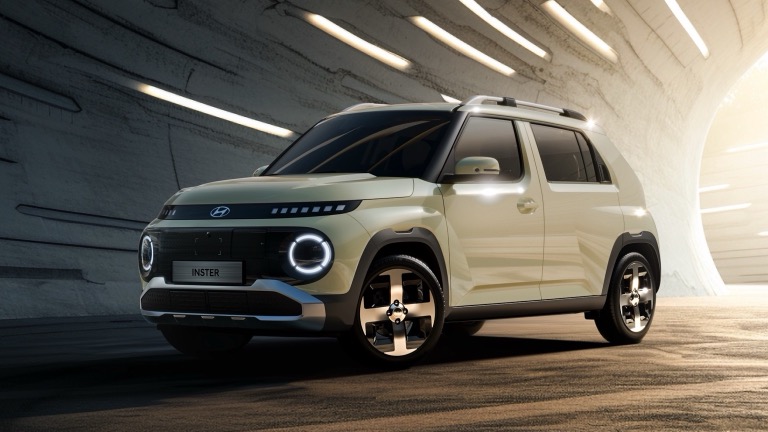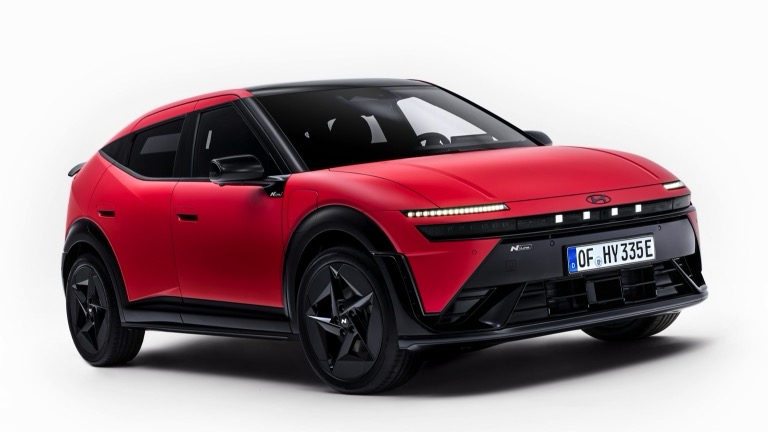

The Hyundai IONIQ 3 61 kWh (MY27) has been on sale since 2026. It has front-wheel drive, a 58 kWh usable battery and an official WLTP range of 496 km (308 miles). On a motorway at −7 °C, our estimate is about 288 km (179 miles). It charges at up to 115 kW DC, makes 100 kW (134 hp) and reaches 100 km/h in 9.6 s.
One of 2 versions: all Hyundai IONIQ 3 versions
One-stop highway day · 399 km248 mi in 3h 53min
Estimates, not measurements: the WLTP figure scaled by the same temperature and road factors for every car (for example 58% for motorway driving at −7 °C, 115% for city driving at 20 °C). Your range depends on speed, wheels, load and heating. Set your own temperature and speed in the range calculator; for a planned stop, use the charging simulator.
Calculated from sustained 10-80% DC fast charging speed, cold-weather aerodynamic drag, and official WLTP range (496 km308 mi).
The official combined WLTP range for the Hyundai IONIQ 3 61 kWh(MY27) is 496 km (308 miles).
In winter at motorway speed, our estimate is about 288 km (179 miles), 58% of the WLTP figure at −7 °C: cold battery chemistry, cabin heating and aerodynamic drag all cost range. Try your own conditions in the EV range calculator.
Charging the 58 kWh battery from 0% to 100% takes approximately 4.7 hours using a standard 11 kW 3-phase AC wallbox. On a single-phase 7.4 kW home charger, a full charge takes around 7.1 hours (typically overnight).
The Hyundai IONIQ 3 61 kWh(MY27) supports peak DC fast charging rates of up to 115 kW. Recharging from 10% to 80% State of Charge (SoC) requires approximately 29 minutes at a compatible ultra-rapid charging station.
At an average European residential electricity tariff of €0.24/kWh, a complete 0-100% home charge costs approximately €13.92. At high-power public DC charging networks (~€0.65/kWh), a full recharge costs approximately €37.70.
The Hyundai IONIQ 3 61 kWh(MY27) delivers 100 kW (134 hp) with a 0-100 km/h sprint time of 9.6 seconds.