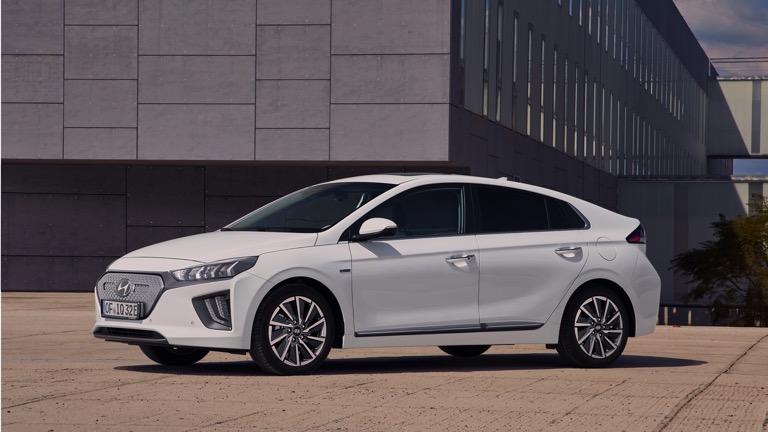

The Hyundai IONIQ Electric was built from 2019 to 2022. It has front-wheel drive, a 38.3 kWh usable battery and an official WLTP range of 311 km (193 miles). On a motorway at −7 °C, our estimate is about 180 km (112 miles). It charges at up to 44 kW DC, makes 100 kW (134 hp) and reaches 100 km/h in 9.7 s.
One of 2 versions: all Hyundai IONIQ Electric versions
Last catalog price before production ended.
One-stop highway day · 230 km143 mi in 2h 20min
Estimates, not measurements: the WLTP figure scaled by the same temperature and road factors for every car (for example 58% for motorway driving at −7 °C, 115% for city driving at 20 °C). Your range depends on speed, wheels, load and heating. Set your own temperature and speed in the range calculator; for a planned stop, use the charging simulator.
Calculated from sustained 10-80% DC fast charging speed, cold-weather aerodynamic drag, and official WLTP range (311 km193 mi).
The official combined WLTP range for the Hyundai IONIQ Electric is 311 km (193 miles).
In winter at motorway speed, our estimate is about 180 km (112 miles), 58% of the WLTP figure at −7 °C: cold battery chemistry, cabin heating and aerodynamic drag all cost range. Try your own conditions in the EV range calculator.
Charging the 38.3 kWh battery from 0% to 100% takes approximately 3.1 hours using a standard 11 kW 3-phase AC wallbox. On a single-phase 7.4 kW home charger, a full charge takes around 4.7 hours (typically overnight).
The Hyundai IONIQ Electric supports peak DC fast charging rates of up to 44 kW. Recharging from 10% to 80% State of Charge (SoC) requires approximately 51 minutes at a compatible ultra-rapid charging station.
At an average European residential electricity tariff of €0.24/kWh, a complete 0-100% home charge costs approximately €9.19. At high-power public DC charging networks (~€0.65/kWh), a full recharge costs approximately €24.89.
The Hyundai IONIQ Electric delivers 100 kW (134 hp) with a 0-100 km/h sprint time of 9.7 seconds.